Taeyong Art Teacher Made You Want to Do Better
Inviting Creativity: The Teacher's Function in Art

At that place are many dissimilar ways to approach the teaching of art. This article identifies and critiques teacher-directed, teacher-guided, and child-centered approaches. What is the instructor'southward part in children's art?
An adult does not need to be a talented creative person to provide meaningful fine art experiences for children, but can stimulate, guide, and model creativity and exploration. Most of usa recognize the importance of early childhood art, but not anybody would agree nigh what it entails. Is scribbling art? Tin can coloring in a coloring book be considered art? This article provides guidelines for determining the artistic merits of an activity or approach to art.
Approaches to Teaching Art
Teacher-directed:
Some art projects are structured and instructor-directed. The teacher has an idea of what to make and how to go about it. Specific directions are given to ensure a recognizable product. Ofttimes, in that location is trivial input from the children. For example, a teacher distributes a slice of paper with an outline of a tree. The children are instructed to use a dark colour, such every bit black or brownish, to color in the trunk and greenish for the tiptop. They too cut or tear small circles from red construction paper. These are pasted onto the light-green tiptop. The completed apple trees expect almost identical. Mostly, this approach is used when art is approached with the entire group or pocket-size groups of children. Most craft projects are teacher-directed. Seefeldt (1995) critiques teacher-directed fine art. Request children to complete patterned artwork or to copy developed models of fine art undermines children's sense of psychological safety and demonstrates disrespect for children including their ideas, abilities, and creativity. Children who are oft given patterns to cutting out or outlines to color in are in fact being told that they, and their art, are inadequate. Seefeldt gives the example of giving children egg cartons to paint and paste eyes to make caterpillars, an activity that she sees equally ridiculous when compared to the artwork of children of Reggio.
Kid-centered:
An opposite approach is to be unstructured and completely kid-centered. A teacher may distribute pieces of paper and encourage children to brand any they want or encourage them to visit the easel or art eye. In this approach, children have much input and choice. There is very piddling construction. Some children do very well with this approach. They may accept a banking company of ideas to correspond through fine art. They may also see countless artistic possibilities at the easel or art center. Many children, however, are uncomfortable with this approach. It may be likewise loosely structured. Some children quickly tire of inventing their own daily art plan. They await to the teacher for some structure, guidance, or possibilities.
According to Wright (2003), unsupported arts learning in the classroom sometimes tin lead to a laissez-faire or "anything goes" type of practice. In this not-interventionist approach, the underlying belief is that whatever children do in the arts in valuable. For a teacher to interfere would stifle a child's creativity. This hands-off arroyo restricts the teacher's role to 1 of organizing the environment only and discourages 1 from suggesting ideas or processes that could mediate and scaffold children's learning. With no input from others, children can sometimes become bored and even frustrated with experiences that invite only contained experimentation. Children cannot create from nothing. They need groundwork ideas and suggestions. Teacher-directed and kid-centered approaches are extremes. Teachers can elect for a compromise using support and guidance past adopting the role of facilitator within a guided approach.
Instructor as Facilitator:
A teacher-guided approach offers the best of the 2 former approaches: subtle structure with much child direction and input. For case:
- A teacher supplies the theme.
"Children, it's getting very close to summer. Today, we volition make a moving-picture show that reminds us of this season." Although the theme is given, there is no specified product. Children are costless to use paint, crayons, markers, or clay to brand their own versions of what summertime means to them. - A instructor introduces new materials at the art center.
"Today I put some spools and buttons near the easels and art table. I want you lot to look at them and think of how they might be used in art. Try out unlike ways of using them." Children are free to use them as brushes, make a stamped impression, or paste them to a collage, as long as the rules for the art center are upheld. - A teacher extends or builds upon an existing action or suggests a new technique.
"I've noticed how much we relish easel painting with our long-handled brushes. I found these small-scale tree branches outside and am leaving them at the easels. Let's come across if we could use them to paint with." Or, "Let me testify you another way of doing watercolor by kickoff wetting your paper." Or, "I see how much you enjoy your paper-bag puppet. If you like, I could bear witness you how to run up one out of textile." Or, "Did y'all enjoy your paper weaving? Would yous similar to acquire how to weave on a loom with yarn?" - A instructor poses a problem.
"Let's encounter how many different shapes we tin can cut out of paper for pasting." Or, "How could we apply these empty boxes and ribbon?" Or, "What will happen if we try painting on paper or the colored pages in this magazine?" - A teacher extends fine art into other curricular areas.
"There seems to be a lot of excitement in your motion picture. Would you like to share it by telling me a story?" Or, "The dog you lot painted looks so happy, let's work together and write a poem nearly it." Or, "Perchance yous would like to plan a play for your ferocious dinosaur."
Different approaches may piece of work for certain activities and sure children. Young children will non automatically notice how to use a watercolor set. They will need some management and didactics in its use and care. They need not, however, be told what to make or what it should look like. For example, Emily is having difficulty deciding what to include in her summer flick. Her teacher senses her frustration and asks her to name things that remind her of summer. Emily answers, "Sun and pond." Her instructor further structures the task by asking Emily to choose one. With the teacher's subtle guidance, Emily chooses the sunday and now must decide if she should utilise paints, watercolor, crayons, markers, or clay to represent it.
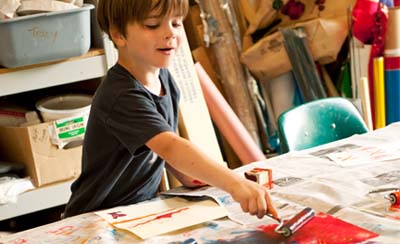
Young children volition need some management and educational activity when presented with new art tools and materials.
Kid-Centered Fine art or Teacher-Directed Projects?
Arts and crafts are terms that are often viewed equally opposite. Hirsch (2004) provides a stardom. The motivation for fine art comes from inside the kid. Young children are dealing with autonomy and initiative. They are frequently not responsive or interested in instructor-directed experiences. This is especially truthful with fine art. When art is forced or extrinsically motivated, it may lack meaning, expressiveness, or particular. The art may reflect external expectations, or the autonomous child may purposefully create anything but what was asked for. The approach is reproductive in that the child merely reproduces the teacher's product.
Past contrast, when the motivation and purpose for art comes from inside the kid, the artwork reflects personal meaning and purpose. When children have gratis access to materials in an art middle, they have the opportunity to create significant and purpose. The arroyo is productive, not reproductive. In terms of approach, art activities are viewed every bit developmentally appropriate while crafts are often teacher-directed, product-oriented, and lacking artistic merit. The term project is presently used in place of craft. Although some would refer to teacher-directed activities equally crafts, the terms are not interchangeable. Crafts accept creative merit, and craftspeople work long and difficult to produce products, many of which reflect their culture. Crafts may also be functional as with candles, jewelry, clothing, or wind chimes. Therefore, it would not be fair to use crafts in the same sense of teacher-directed art projects. Instead, instructor-directed projects, rather than crafts are the opposite of child-centered art. Substituting teacher projects for art does children a disservice for it robs them of the opportunity to make self-expressive, cocky-initiated art.
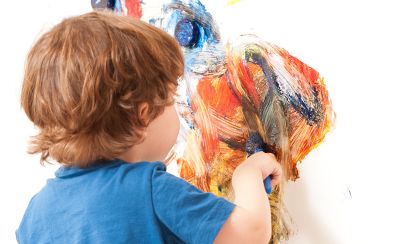
In a child-centered art activeness the finished product may not be recognizable!
Child-Centered Art Activities or Teacher-Directed Projects
Fine art Activities | Teacher-Directed Projects |
| are creative, unique, original | announced mass-produced and very similar |
| are open-ended and unstructured | are airtight-ended and structured |
| are child-centered and kid-directed | are teacher-centered and teacher-directed |
| come from within the child | are imposed from without by the teacher |
| involve self-expression | involve copying and imitating |
| foster autonomy | foster compliance and following directions |
| are process-oriented | are product-oriented |
| may non appeal to adults because the finished production may not be recognizable | usually entreatment to adults because the finished production is recognizable |
| may not be useful or applied | may be useful and applied |
| are success-oriented, no fear of failure | may be unsuccessful if the kid is unable to approximate the teacher's model or standard |
| empower children to determine on content | are decided by the instructor and related to vacation, flavour, theme, unit of written report |
| delight the child | please adults |
| demand open blocks of time | may involve time constraints |
Is There a Place for Teacher Projects?
Although teacher projects should not boss your art programme, they do take a place and are to your art program as spices are to cooking. Some people avoid spices while others use them sparingly to raise but not overpower or dominate the taste of nutrient. When should teacher projects be used? They can be used occasionally
- with older children who have a solid foundation in processing and are interested in learning how to make fine art products.
- when children tire of visiting the art center and announced to run out of ideas for processing. They announced stuck or out of ideas. Information technology appears the art center is not existence used.
- to introduce children to new cultures by directly experiencing representative crafts. The process involved in making crafts must be tailored to meet the developmental needs of your group.
- while allowing for private expression, equally in the selection of color or type of decoration added. For example, children tin can be taught how to make a piñata without specifying what it should look similar when finished.
From Art and Creative Evolution for Young Children5th edition by Robert Shirrmacher. © 2006. Reprinted with permission of Delmar Learning, a sectionalisation of Thomson Learning.

gonzalesdreff1942.blogspot.com
Source: https://www.communityplaythings.com/resources/articles/2006/child-centered-art-vs-teacher-directed-projects
0 Response to "Taeyong Art Teacher Made You Want to Do Better"
Post a Comment